The system
A screen where you are and a node at the tank
Two pieces do the work. The Display Pod is the screen, and it goes where you do. The Tank Node is what actually sits beside the water and watches it. Everything else on this page either attaches to those two, or is marked not built yet.
Display Pod
The screen, where you areA touchscreen that does nothing else. No phone in your hand, no browser tab, no login before you can see a temperature. Walk past it and the tank has already told you how it is doing.
It is placed, not installed. Put it at the tank, on a table beside it, or across the room where you actually sit, and move it when you change your mind. Nothing gets screwed to a wall.
After an idle timeout you set, it falls back to a clock, or to your own tank photos, and a tap brings the dashboard back. Requiring a PIN on that tap is optional, and so is a PIN on individual tabs, which matters more in a shop than in a living room.
In the box: the Display Pod — the 10 inch touchscreen with controller — one Tank Node, a temperature probe, a level sensor, a float switch, and a power supply for each.
Everything in that list is there to stop something. Temperature, because heat is what kills a tank fastest. Level, because water going the wrong way is what kills it next. And the float, because a level reading is a number and a float is a contact — and when the question is should this heater be allowed to run, a contact is a better answer than a number.
The node has ten places to put a sensor and this kit fills two of them. The float costs you none of them. The temperature circuit does not need electrical isolation, the level sensor reads from above the water without touching it, and the float is a dry contact on an input of its own. All eight isolated channels are still open. They arrive without probes on purpose: a probe you did not choose is one you will end up replacing on somebody else's schedule.
The level sensor does two jobs. It watches the sump continuously, so the controller can tell a stalled return from an ordinary night — water rising when the pump stops is the thing no other reading gives you. And it will run your auto top-off.
There is one in the box, not two. If you want the top-off on its own sensor, that is the second one — and there is a reason to want it beyond having a spare: the sensor pouring water into your sump should not also be the one watching your sump for trouble. Give the top-off its own and the one watching stays independent of the one acting. A second is also the answer if you want to know when the top-off reservoir has run dry. That is a different vessel and a different question.
The float is a contact, not a reading, and that is the whole point. There is one, set where you decide the water is too high — mounting it is the calibration. Wired so healthy is closed, a broken wire, a pulled connector and a dead switch all report the alarm.
It also sits where the water usually is not — above the line, out of the chemistry, away from the snails. That is the opposite of where a top-off float lives, and half the reason that job goes to the level sensor instead.
And because the level sensor reads the same water by a different method, the controller knows what the float should be saying. When they stop agreeing, that is a fault, and you are told — which is the honest answer to the only real objection to a float, that floats stick.
The controller reads that contact and cuts the heater over the network, and that part is still in testing. Designed and decided, not built: when Pharos Power exists, that same contact sits in series with the heater outlet's own relay, the way a pool heater's does. The software can open that outlet and cannot close it against an open float. That is the version where the interlock survives the controller being wrong.
What is included is what protects. What you add is what automates.
It is also a lit screen in a room you live in. Three palettes ship with it, and under those are eight color roles you can set yourself, including background, accent, text and the three status colors. The preview updates live, before you apply anything. A screen that stays lit should be able to sit quietly in a room instead of glowing at it.
The enclosure is the last piece, on purpose. How this behaves is already settled: the interface, where the safety limits live, what happens when the network drops. A case changes none of that. It is the one part still open, and the one part where your opinion is worth more than another month of mine.
Tank Node
Placed within reach of the probesThe node goes where the water is, so probe runs are short. It holds its own safety limits and keeps enforcing them whether or not the Pod is reachable.
A probe cable is about three feet, and that is what sets the layout. The node sits within reach of everything it reads, so placed between a display and its sump it covers about six feet end to end. On most reefs the chemistry all lives in the sump and one node covers the whole system. A system spread wider than that takes two, and it is still one system — the limits, the history and the alerts stay together under it. Two separate systems never share a node.
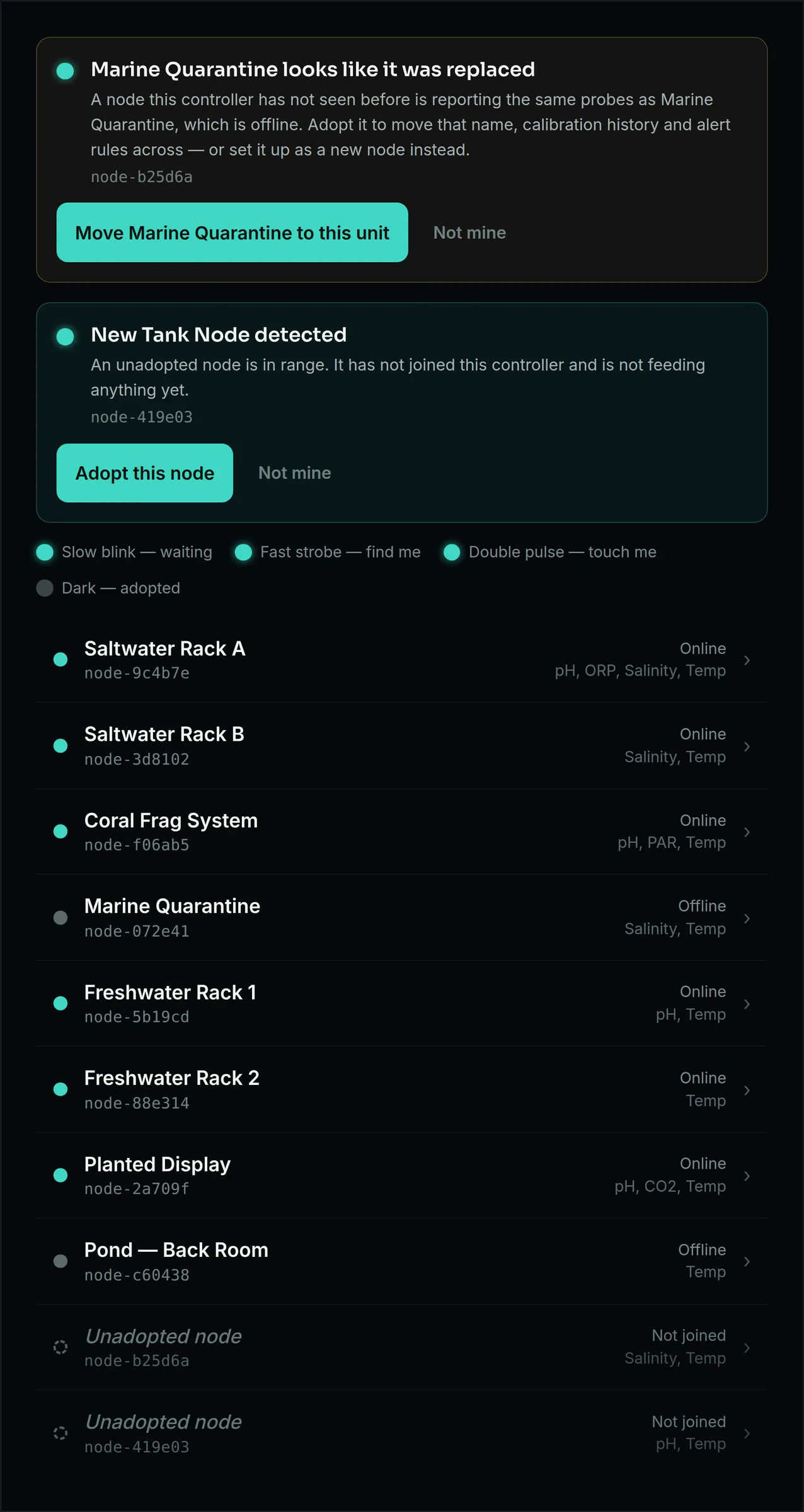
It carries a fixed hardware ID alongside the name you give it, taken from the radio MAC burned into the board at the factory. Rename it, reset it, reflash it, restore a config — the history stays with it.
Replace the board and you have a different unit with a different ID, so it arrives empty. The controller sees it has taken the old one's place and offers to move the name, the calibration history and the alert rules over. You say yes, or you don't.
A Pod carries up to three nodes. Three covers a display and its sump, a frag system and a quarantine tank, which is where most reef rooms stop. That is the line between this and the store version rather than a limit of the hardware — the store build is the same box with the cap lifted.
Probe channels
Eight isolated, all of them yoursEight electrically isolated channels are built onto the board and all eight are yours. Every node is the same board: there is no version with fewer channels, and nothing on the node to unlock. Isolation keeps a probe sitting in the water from sharing a ground with the rest of the controller, and it costs less to build every channel that way than to decide later which ones deserved it.
Temperature and level arrive populated on their own inputs, so every one of the eight is free. All eight are visible in the interface from the first boot, unlit, waiting. You buy probes on your own schedule and replace them on their own schedule, because that is how probes actually get used.
- Temperature its own input, populated
- Level its own input, populated
- Eight isolated channels visible, unlit, yours to fill
Calibration
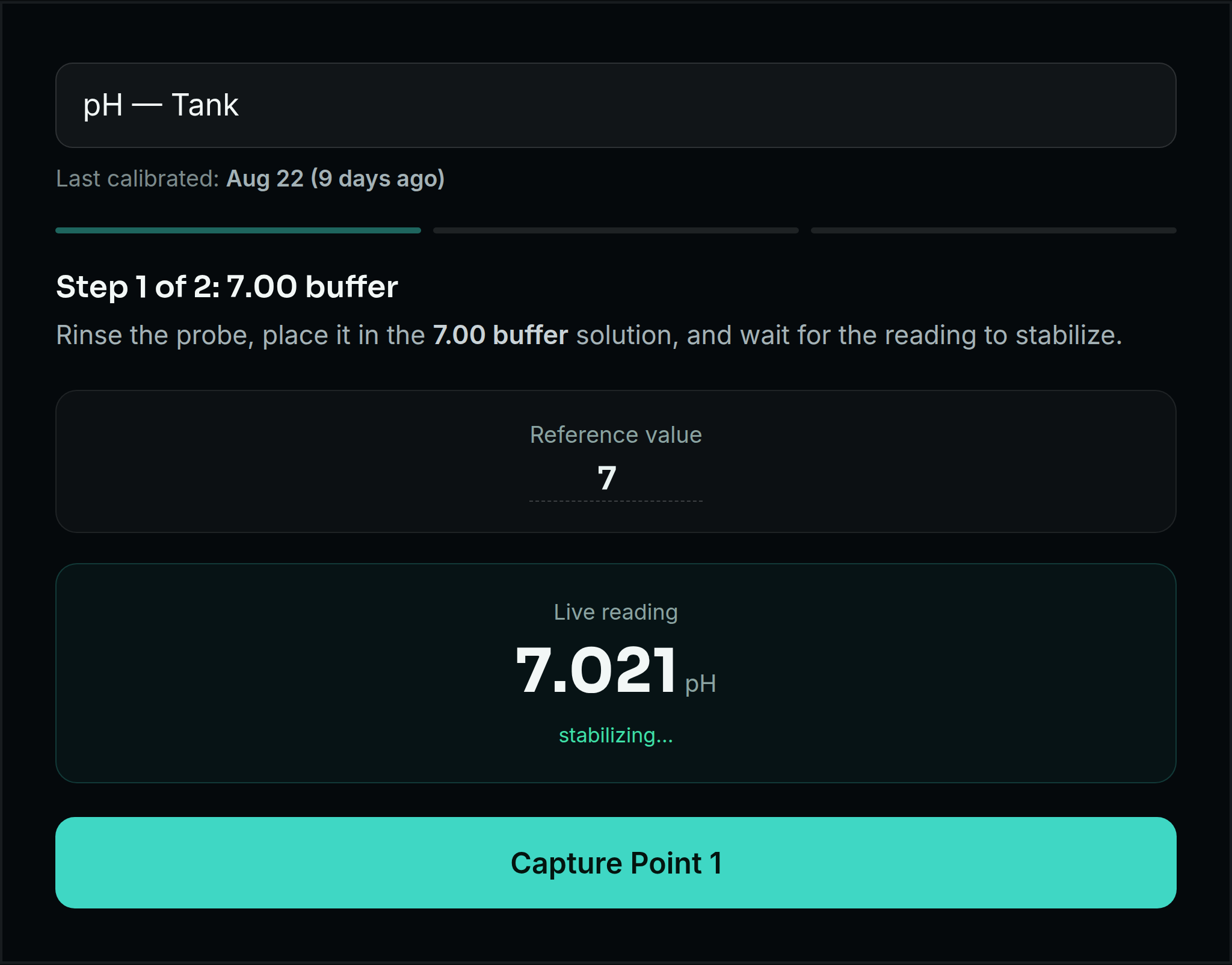
When the probe is the problemCalibration is two points for pH, one for ORP and salinity. The screen walks it: rinse, place, wait for the reading to settle, capture. The buffer value is editable, because the number on your bottle is the one that matters.
At the end it works out the slope and says how far off ideal it is. A probe reading 70% of ideal slope is not miscalibrated, it is worn out, and that is the number that tells you to buy a new one. Every probe carries the date it was last calibrated, because a reading is only as good as how long ago you proved it.
Pharos Power
Designed and decided, not builtSwitched and monitored outlets, as a separate device on its own. Mains power never enters the Pod or the Node. That separation is the whole reason it is a different box rather than a bigger one.
Outlets can be interlocked. The heater is allowed to run only while the return pump is pulling the load of a pump with water in it, and that is checked before the heater comes on and again the whole time it is on — the failure that matters is the pump dying while the heater is already running, and a check that only happens at switch-on would sleep through it. It is held on the outlet itself rather than in the app, which is what keeps it true when the network is not.
What the outlet measures is different on the two rails, and it has to be. On the twelve volt ports, current is the honest answer: the voltage is fixed, so amps and watts are the same fact. On mains it is not. A pump running dry still draws about as many amps as a pump moving water — the working current falls and the reactive current rises to fill the gap — so a mains outlet that watched current would sit and watch a dry sump being heated. It watches real power instead, which drops by roughly half the moment flow stops. This is the kind of thing that has to be decided before the board is laid out rather than after, because it is a different part.
It still will not catch every way a pump can fail. A blocked intake or a fouled impeller sits somewhere between those two, and the honest answer there is a flow sensor, not a cleverer reading of the outlet.
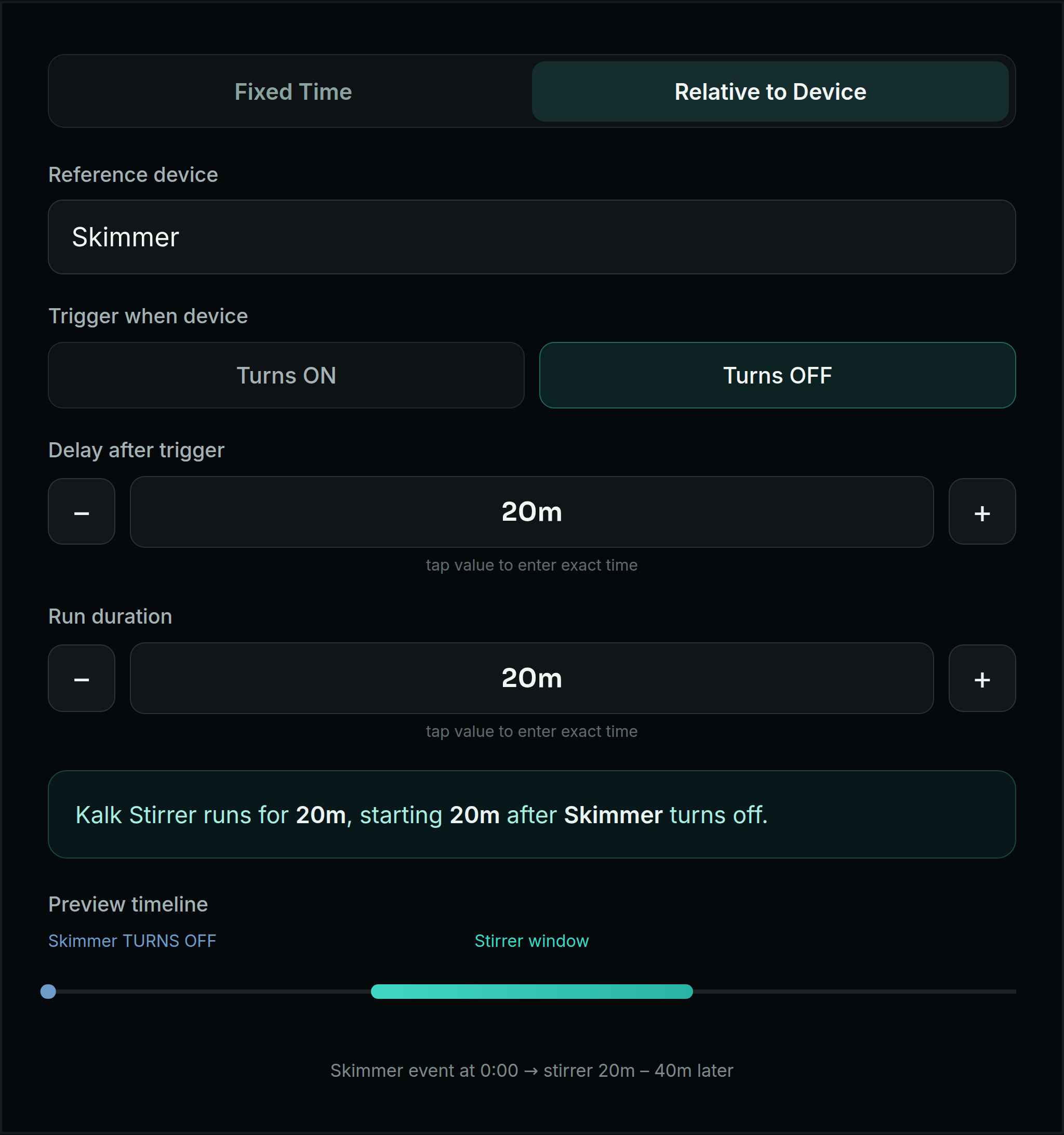
The scheduling that will drive those outlets is already built. A schedule is either a clock time or another outlet — run for twenty minutes, starting twenty minutes after the skimmer turns off — and the settings screen works the relationship out while you set it, drawing the timeline and reading the rule back as a sentence instead of leaving you to decode a table.
Away from the tank
The screen is the point, not the limitThe screen in the room is what you use every day, because it is already on and already showing you the answer. That is where the good interface lives. It is not a fence around where you can be.
From anywhere else, you can look in and see the same parameters and the same alerts on your phone. Checking your reef from an airport is an entirely reasonable thing to want to do.
What it does not do
One is a decision. One is not built yet. Each says which.
- No automated alkalinity testing. Reagents drift and lines clog, and a controller acting on a wrong number is worse than one with no number at all. So the kit on your shelf stays the source, and a hand result goes into the same record as everything the probes read, with the same history behind it.
- Not shipping. The first system is being built for a 120 gallon SPS and LPS mixed reef, and a second, smaller tank is there to be broken on purpose. Nothing is installed yet, and nothing goes on sale before it has been through safety certification.
Your turn
The screen is settled. I am open on the rest.
The Display Pod will ship with a 10 inch panel, and that part is chosen — chosen by what a Pi 5 can actually drive, not because it is the size everyone wants. It is placed rather than installed, so where it goes is already your call. What is not settled is what gets built around that: how it is finished, what it should sit on or hang from, and whether a second screen across the room is worth building at all. That I cannot settle from one tank in one room.